
List of Companies That Use Zendesk
177,000+ Global Companies | 14.64% CX Market Share
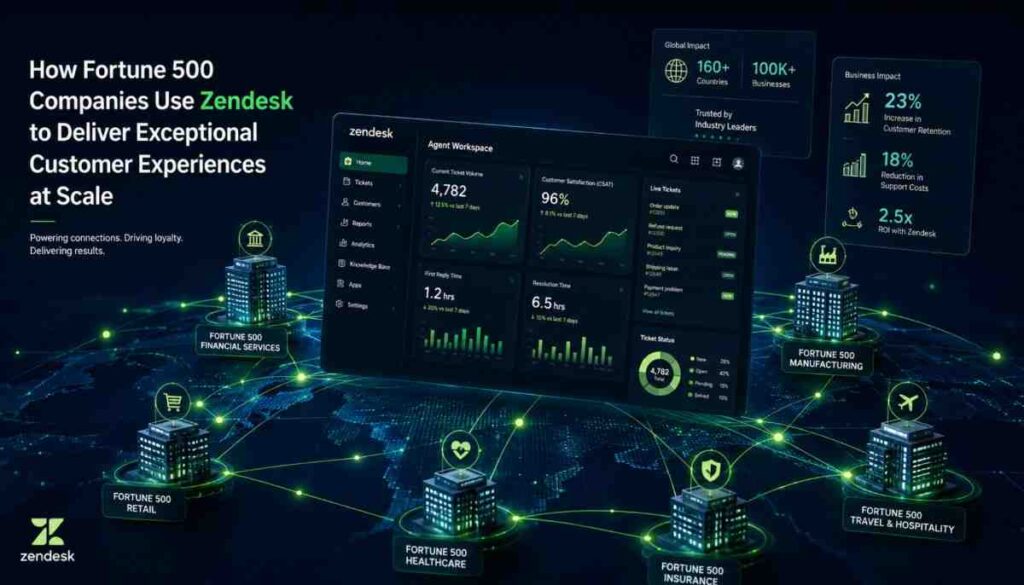
What Exactly Is Zendesk?
Zendesk is a cloud-based customer service and engagement platform that gives businesses a centralized hub to manage support tickets, live chat, phone, email, and social media interactions all from one place. Founded in Copenhagen in 2007, it has grown into one of the most recognized names in customer experience software.
Unlike a simple helpdesk, Zendesk is a full CX ecosystem. Its suite spans Support (ticketing), Chat (live messaging), Talk (voice), Guide (self-service knowledge base), Sell (CRM), and increasingly, AI-powered automation tools. The platform connects agents, customers, and data in a way that scales from a two-person startup to a global enterprise.
What sets Zendesk apart is its philosophy: customer service should not be a cost center it should be a growtWhat sets Zendesk apart is its philosophy: customer service should not be a cost center it should be a growth driver. That idea has resonated deeply with over 177,000 businesses worldwide.
Why Do Leading Companies Choose Zendesk?
When you look at the organizations running Zendesk from Airbnb to Shopify to Netflix a clear picture emerges. It is not just about managing tickets. It is about building a support operation that scales, adapts, and competes.
Here is what drives adoption at the highest levels:
Omnichannel in one place. Email, chat, phone, and social media agents handle every channel from a single, unified workspace without switching between tools or tabs.
AI and automation. Bots handle repetitive queries. Smart routing reduces wait times. AI surfaces relevant help articles before customers even finish typing their question.
Scales with growth. Zendesk works equally well for a 5-person team and a 5,000-agent enterprise operation without requiring a costly platform migration or rebuild as the business grows.
1,500+ integrations. The platform connects natively to Salesforce, Slack, Shopify, HubSpot, and hundreds of other tools through the Zendesk Marketplace, fitting into almost any existing tech stack.
Reporting and analytics. Zendesk Explore provides deep analytics on CSAT scores, resolution times, agent performance, and ticket volume trends turning support data into strategic insight.
Enterprise-grade security. HIPAA, SOC 2, and GDPR compliance are baked into the platform a critical requirement for healthcare, finance, and other regulated industries.
Market Share: Where Zendesk Stands in 2026
Zendesk holds a commanding position in the customer experience software landscape. According to 2026 data, over 177,744 companies have deployed Zendesk as their primary customer experience or contact center tool making it one of the most widely adopted platforms in the space.
In the customer experience category, Zendesk holds 14.64% market share, ahead of Intercom (13.27%), Trustpilot (12.72%), and Adobe Experience Cloud (9.13%). In the broader customer service management space tracked by Enlyft, Zendesk commands 13.91% market share across more than 205,000 companies data collected over more than a decade of technology tracking.
Zendesk’s nearest competitor, Intercom, trails by over a full percentage point in the core CX category. For B2B sellers and marketers, this dominance means that Zendesk users represent one of the most concentrated, identifiable, and high-intent technology audiences available to target.
Want to Target Zendesk Users in SaaS? Access the Full List Instantly!
Our verified, GDPR-compliant database of 177,000+ Zendesk-using companies includes decision-maker contacts, firmographics, and full tech stack details ready for your next outreach campaign.
[Get the Full Zendesk User List → https://leadsemails.com/product/companies-that-use-zendesk/]
Top 10 Companies That Use Zendesk Right Now
These are not just Zendesk customers they are organizations that have made Zendesk a cornerstone of their customer experience strategy at genuine scale. Each one is a compelling case study in how the platform drives real business outcomes.
1. Airbnb The global home-sharing marketplace uses Zendesk to handle an enormous volume of support tickets from both hosts and guests across every continent. Zendesk’s automation features allow Airbnb to streamline support operations, reducing response times and maintaining consistent service quality across all communication channels.
2. Shopify With over one million merchants on its eCommerce platform, Shopify relies on Zendesk to provide a seamless omnichannel experience across email, live chat, phone, and social media. Zendesk’s reporting and analytics capabilities help Shopify gain valuable insights into merchant interactions and continuously improve its support strategy.
3. Uber The ride-sharing giant manages real-time support for millions of riders and drivers across more than 70 countries simultaneously. Zendesk’s scalability and routing capabilities are critical to keeping Uber’s support operations responsive at that level of volume.
4. Netflix The streaming leader leverages Zendesk’s analytics and reporting tools to monitor subscriber satisfaction and identify friction points before they escalate into churn. Support quality at Netflix is treated as a direct retention lever.
5. Amazon Amazon uses Zendesk in select B2B and enterprise divisions where structured ticketing systems, SLA tracking, and formal escalation workflows are required particularly in its AWS and seller support operations.
6. Slack (Salesforce) Slack powers its internal and external support workflows through Zendesk, taking full advantage of the deep native integration between both platforms. For a company whose product is communication, its support tooling reflects that same standard.
7. Sony The consumer electronics and entertainment giant centralizes global product support across PlayStation, audio equipment, and hardware divisions through Zendesk giving regional teams a unified view of customer interactions worldwide.
8. T-Mobile The telecom carrier scales support operations for tens of millions of subscribers using Zendesk’s AI-assisted triaging, smart routing, and agent workspace tools to maintain service quality under extreme ticket volumes.
9. Shell The global energy company uses Zendesk for enterprise B2B support, managing complex, multi-stakeholder service workflows that span procurement, logistics, and technical assistance across global business units.
10. Vimeo The video platform supports its global creator community through Zendesk’s self-service tools and proactive support capabilities, helping creators resolve issues faster and spend more time producing content.
Zendesk Adoption Across Industries
Zendesk’s versatility is perhaps its greatest commercial asset. The platform has found deep roots across wildly different sectors, each with distinct support demands.
SaaS and Technology (~34% of Zendesk customers) The largest single vertical. Tech companies depend on fast, scalable support to retain subscribers and reduce churn, making Zendesk a natural fit for their operations.
eCommerce and Retail (~18%) Merchants live and die by post-purchase customer experience. Zendesk’s omnichannel tools and order management integrations make it the go-to choice for online retailers of all sizes.
Finance and Banking (~12%) Financial services firms adopt Zendesk specifically because it meets strict compliance requirements while offering the workflow flexibility and audit trail capabilities their industry demands.
Healthcare (~9%) HIPAA-compliant support workflows, secure messaging, and escalation management make Zendesk a trusted platform for healthcare providers, health tech companies, and insurance organizations.
Travel and Hospitality (~8%) Airbnb’s use case is representative of a broader trend. High-volume, time-sensitive customer inquiries in travel require exactly the kind of automation and omnichannel capability Zendesk provides.
Education (~7%) The shift to digital learning has pushed education institutions and EdTech platforms toward platforms like Zendesk to manage student inquiries, technical issues, and faculty support at scale.
Global Distribution of Zendesk Users
Zendesk’s footprint is overwhelmingly North American, but it has genuine global reach across six continents.
- United States: 56.53% approximately 76,723 companies
- United Kingdom: 10.36% approximately 14,065 companies
- Brazil: 4.91% approximately 6,666 companies
- Rest of World: ~28% distributed across Europe, Asia-Pacific, and Latin America
North America accounts for roughly 65% of all Zendesk users when Canada is included alongside the US. The UK’s strong showing reflects the platform’s popularity among London-based fintech startups, SaaS companies, and digital retailers. Brazil’s presence points to Zendesk’s growing traction in Latin America a region experiencing rapid expansion in digital commerce and customer experience investment.
Employee Size Breakdown of Zendesk-Using Companies
One of the more revealing facts about Zendesk’s user base is how it skews toward smaller businesses yet simultaneously counts some of the world’s largest corporations as customers. This duality reflects the platform’s genuine price-range flexibility.
Employee Size Distribution
| Company Size | Number of Zendesk Customers |
| 0–9 employees | 60,833 companies |
| 20–49 employees | 44,704 companies |
| 100–249 employees | 27,804 companies |
| 250–999 employees | ~18,000 companies |
| 1,000+ employees | ~12,000 companies |
The micro and small business segments together account for the majority of Zendesk’s global customer count. For B2B sellers, this is a critical insight: a strategy that focuses exclusively on enterprise names like Netflix and Airbnb misses the vast majority of the addressable market. The SMB segment companies with 10 to 50 employees in the $1M–$10M revenue range represents higher volume, shorter sales cycles, and in aggregate, enormous total revenue potential.
Revenue Segments of Companies Using Zendesk
Zendesk Users by Annual Revenue
Understanding the revenue profile of Zendesk’s customer base clarifies where to focus B2B outreach and how to size opportunity by segment.
$1M–$10M (SMB) Largest segment. The core of Zendesk’s SaaS customer base. These are typically fast-growing tech companies and digital-first retailers with 10 to 50 employees who need professional support tooling without enterprise-level complexity or pricing.
$10M–$50M (mid-market) Strong presence. Companies at this stage are actively investing in their customer experience stack. They have the budget to buy complementary tools and the complexity to need them.
$50M–$500M (upper mid-market) Significant adoption. Organizations at this revenue scale are often running Zendesk across multiple teams and geographies, creating more sophisticated integration and data needs.
$500M+ (enterprise and Fortune 500) High-value segment. These accounts represent the highest contract values and the most complex implementations. Enterprise Zendesk customers often use the full suite Support, Chat, Guide, Explore, and Talk along with custom integrations and dedicated account management.
How to Target Companies That Use Zendesk for B2B Sales
Knowing that a company runs Zendesk is not just interesting data it is a powerful buying signal. Companies that have invested in a premium customer experience platform are actively prioritizing CX, have allocated technology budget, and are open to tools that improve their operations. Here is a proven approach for converting Zendesk users into your customers.
Start with segmentation, not a spray-and-pray list. Filter your Zendesk audience by industry, employee size, and revenue range before you write a single email. A 10-person SaaS startup and a 10,000-employee telecom both use Zendesk but they have completely different buying processes, pain points, and decision-makers.
Lead with integration, not competition. If your product complements or integrates with Zendesk, position it as an enhancement rather than an alternative. “We plug into your existing Zendesk setup to do X” consistently outperforms “switch from Zendesk to us” in both response rate and deal velocity.
Reach the right decision-maker. At SMBs, the Zendesk decision-maker is typically the Head of Customer Success or the founder. At enterprise, you are selling to a VP of Customer Experience, Head of Support Operations, or IT procurement. The title, channel, and message need to change accordingly.
Leverage full tech stack signals. Companies using Zendesk commonly pair it with Salesforce, HubSpot, Intercom, or Shopify. Knowing the surrounding stack lets you craft context-specific pitches that feel genuinely relevant rather than generic outreach blasted at a list.
Use verified, compliant contact data. Cold outreach built on outdated or scraped lists fails at the deliverability level before it ever reaches the prospect. A verified Zendesk user database with confirmed contacts, current job titles, and opt-in compliance delivers measurably better open rates, reply rates, and campaign ROI.
Tips for Targeting Zendesk Users
Personalize around their pain, not just their tool. “I see you’re using Zendesk” is a weak opener. “Companies at your stage using Zendesk typically hit X bottleneck around Y ticket volume per month” shows you understand their operational reality and have something worth saying.
Run multi-channel sequences. LinkedIn plus email plus targeted display ads working in concert outperforms any single channel. Zendesk users are digital-native buyers who are responsive to well-coordinated, professional outreach across channels.
Time outreach to renewal cycles. Zendesk contracts typically renew annually. Initiating outreach 60 to 90 days before renewal when teams are actively evaluating their stack and budget is under review produces dramatically higher response rates than cold outreach at random.
Build Zendesk-specific content assets. A comparison guide, integration walkthrough, or ROI calculator built specifically for Zendesk users performs significantly better than generic content in both paid advertising and organic search. Specificity signals relevance.
Segment by industry vertical. A healthcare company using Zendesk has compliance concerns that a SaaS startup does not. Industry-specific messaging converts at two to three times the rate of horizontal pitches aimed at all Zendesk users equally.
Test account-based marketing for enterprise targets. For high-value Fortune 500 Zendesk accounts, a full ABM approach combining targeted advertising, direct mail, executive outreach, and personalized content sequences pays off significantly given the contract sizes involved. The investment is proportionate to the return.
Final Thoughts
The 177,000+ companies running Zendesk in 2026 represent one of the most clearly defined, high-intent technology audiences in the B2B world. These are organizations that have already decided customer experience matters, have allocated budget to it, and are actively investing in tools that improve it.
Whether you are selling a complementary SaaS product, a professional services offering, an integration, or a competing platform, the Zendesk user base is a remarkably fertile market — provided you approach it with accurate data, a relevant message, and disciplined timing.
The companies in this list from Airbnb’s global hospitality operation to a 12-person SaaS startup in Austin share one signal: they take customer experience seriously. If your solution helps them do that better, you already have something worth saying to them.
Looking to Market Your Solution to Companies That Use Zendesk?
Access our verified, continuously updated database of Zendesk-using companies — filtered by industry, revenue, company size, and geography. GDPR-compliant. 95%+ data accuracy guaranteed.
[Get Instant Access to the Full List → https://leadsemails.com/product/companies-that-use-zendesk/]
FAQs
How many companies use Zendesk globally in 2026? Over 177,744 companies worldwide have adopted Zendesk as their customer experience or contact center platform as of 2026. Some sources tracking broader usage patterns place the number closer to 205,000 when including partial and historical deployments.
Which country has the most Zendesk users? The United States accounts for 56.53% of all Zendesk customers approximately 76,723 companies. The UK is second at 10.36% (14,065 companies), followed by Brazil at 4.91% (6,666 companies).
Does Zendesk serve mostly small businesses or large enterprises? Both, but the volume is heavily weighted toward SMBs. The largest single customer segment is companies with 0–9 employees (60,833 companies). However, Zendesk also serves Fortune 500 companies including Amazon, T-Mobile, and Sony demonstrating that the platform scales to any size.
Which industry uses Zendesk the most? The SaaS and technology sector accounts for the largest share of Zendesk users, followed by eCommerce, financial services, and healthcare. The top three customer categories by product type are Marketing, Technology, and Software.
What is Zendesk’s market share in the CX software space? Zendesk holds 14.64% market share in the customer experience category and approximately 8.26% in the contact center category. In the broader customer service management space, its share is around 13.91% placing it firmly among the top two or three platforms globally.
Can I get a verified list of companies that use Zendesk for B2B outreach? Yes. Verified Zendesk user lists are available from data providers that track technology adoption across millions of domains. Look for providers offering 95%+ data accuracy, GDPR compliance, opt-in contacts, and filtering by industry, employee size, revenue, and geography.
Who are Zendesk’s main competitors in 2026? In the customer experience category, Zendesk’s top competitors are Intercom (13.27%), Trustpilot (12.72%), and Adobe Experience Cloud (9.13%). In the contact center space, alternatives include Freshworks, Agile CRM, and Salesforce Service Cloud.
