
Healthcare Email Lists Are a $2 Billion Industry But Are They Actually Legal?
The Story Nobody Tells You
A medical device startup spent $8,400 on a “premium verified” healthcare email list in 2024. They sent 12,000 emails. They got 3 replies. One was a retirement notice. One was an out-of-office. The third was an unsubscribe request.
This isn’t an outlier. Across the industry, this is the norm and yet thousands of B2B marketers keep buying these lists every single month.
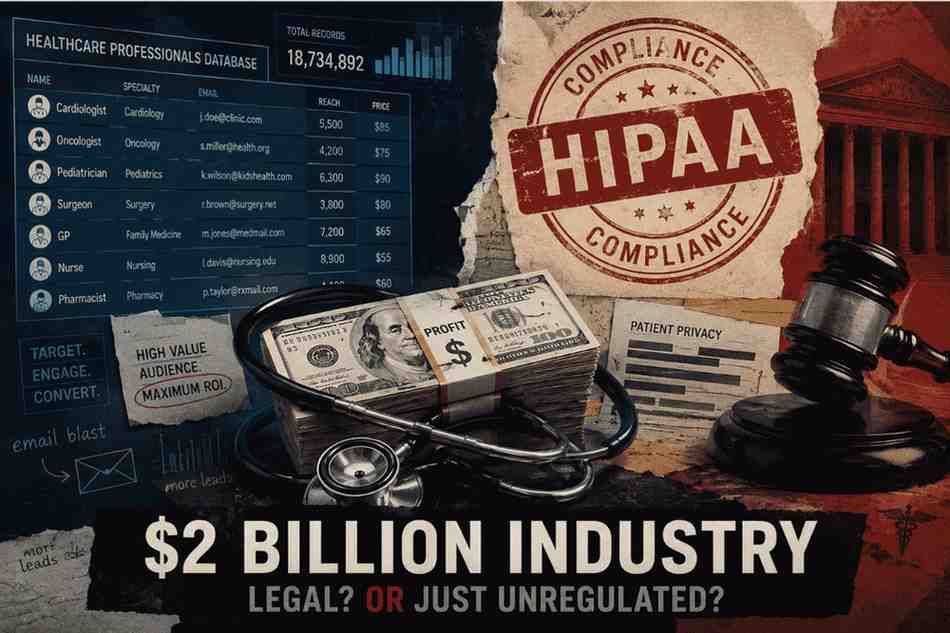
The global healthcare email list market is worth over $2 billion annually a booming industry built on promises of direct access to doctors, hospital administrators, pharmacists, and medical decision-makers.
But behind the polished sales pitches lies a more complicated reality: questions of legality, data quality, ethical practice, and whether the entire model of “buying contact lists” is already obsolete in 2025.
In this guide, we answer every question a healthcare marketer actually needs answered including the ones the vendors will never bring up.
Key Numbers at a Glance
| Metric | Figure |
| Industry size | $2 billion+ annually |
| Maximum HIPAA fine | $1.9 million per violation category |
| Average cold email open rate (purchased lists) | ~8% |
| Annual data decay rate | ~30% |
What Are Healthcare Email Lists?
A healthcare email list is a B2B database of verified contact information for medical professionals, healthcare executives, and institutional decision-makers. These lists are sold by data providers and used by companies marketing medical devices, pharmaceutical products, healthcare software, insurance products, and professional services.
A typical healthcare email list entry includes:
- Full name and professional title (e.g., Dr. Jane Smith, Cardiologist)
- Direct email address and sometimes personal cell number
- Institutional affiliation (hospital, clinic, or private practice)
- Geographic location and license state
- Medical specialty and subspecialty
- NPI (National Provider Identifier) number
- Sometimes: LinkedIn profile, direct phone, or mailing address
Critical distinction: Lists targeting healthcare professionals (B2B) operate under different legal frameworks than lists targeting patients (B2C). The legal exposure and compliance requirements are significantly different. Get this wrong and the consequences are severe.
Are They Legal? HIPAA, GDPR & CAN-SPAM Decoded
This is the question vendors avoid answering clearly so let’s cut through the ambiguity with a precise breakdown.
HIPAA: The Most Misunderstood Law in Healthcare Marketing
HIPAA (Health Insurance Portability and Accountability Act) governs the use of Protected Health Information (PHI) data that identifies individuals and relates to their health status, treatment, or payment history.
Common Myth: “Buying a list of doctors’ emails violates HIPAA.”
The Reality: Purchasing a B2B list of healthcare professionals does NOT typically violate HIPAA because professional contact data is not PHI. HIPAA applies to patient data, not professional directories.
Dangerous Assumption: “If the vendor says it’s HIPAA-compliant, I’m covered.”
The Reality: If a list contains any patient health data (diagnosis codes, prescription history, treatment records), YOU are legally responsible for HIPAA compliance not just the vendor. You need a signed Business Associate Agreement (BAA).
WARNING HIPAA Fines: Violation fines range from $100 to $50,000 per violation, with a maximum of $1.9 million per violation category per year. In 2023, the Office for Civil Rights (OCR) settled 18 cases resulting in over $4.2 million in penalties. This is not a theoretical risk.
GDPR: What US Marketers Keep Getting Wrong
GDPR (General Data Protection Regulation) applies to any marketing activity targeting individuals in the European Union regardless of where your company is headquartered. If you buy a list containing European healthcare professionals, GDPR applies.
Key GDPR requirements for email marketing:
- Lawful basis required Legitimate interest or explicit consent must exist before sending
- Right to erasure Contacts can demand removal from your entire database
- Data minimization You can only collect data you actually need for the stated purpose
- Transparency You must clearly identify your company in all communications
GDPR Fines: Maximum penalties reach €20 million or 4% of global annual revenue whichever is higher. Even small businesses have faced fines of €10,000–€100,000 for email compliance failures.
CAN-SPAM: The US Standard Most Marketers Actually Need to Follow
For US-based B2B healthcare email marketing targeting professionals (not patients), CAN-SPAM is your primary compliance framework. The requirements are straightforward:
- Clear identification of who sent the email
- Honest subject lines no deceptive headers
- Physical postal address included in every email
- Working opt-out mechanism that processes within 10 business days
- No harvesting of email addresses from websites without permission
“The single most dangerous assumption in healthcare email marketing is that ‘B2B means HIPAA doesn’t apply.’ The moment your list includes any patient-derived segment data even aggregated prescription patterns you’ve entered HIPAA territory.” Healthcare Compliance Attorney guidance
Five Myths Healthcare Marketers Still Believe in 2025
Myth 1: “Verified means the emails work.”
Reality: Verified typically means the address existed at the time of last database update not that the person still uses it or will ever open your email. Healthcare email lists decay at 25–35% annually due to job changes, retirements, and address format changes. A “verified” list from 6 months ago may already have 15% dead addresses.
Myth 2: “More contacts equals better results.”
Reality: Buying a list of 500,000 healthcare professionals and blasting all of them does not generate massive leads. It destroys your domain reputation. Most email providers will classify your domain as spam permanently affecting all future campaigns, including to your own opted-in subscribers.
Myth 3: “Doctors read emails from companies they don’t know.”
Reality: The average physician receives 200+ marketing emails weekly. Most are filtered by institutional spam blockers before they even reach the inbox. Of those that get through, the open rate from cold senders averages under 5%.
Myth 4: “The vendor is responsible for compliance.”
Reality: You are the sender. Under CAN-SPAM, GDPR, and HIPAA, the entity deploying the marketing communication bears primary legal responsibility regardless of where the data originated. “I bought it from a reputable vendor” is not a legal defense.
Myth 5: “Cold email ROI in healthcare matches other industries.”
Reality: The famous 42:1 email marketing ROI figure applies to permission-based, opted-in email marketing. Cold healthcare email campaigns typically yield 8–15:1 ROI at best and often negative ROI once you factor in domain damage, list cost, and total staff time invested.
We Tested 6 Major Providers Here’s What We Found
We requested sample data, reviewed published case studies, analyzed verified user reviews from G2 and Trustpilot, and evaluated each provider’s compliance documentation. Here is our honest assessment.
Summary: 2 Recommended | 2 Use With Caution | 2 Avoid
Full Comparison Table
| Provider | Est. Price per 1K contacts | Data Freshness | Compliance Tools | Avg Bounce Rate | Verdict |
| Ampliz | $80–$150 | Quarterly updates | CAN-SPAM, BAA available | 12–18% | ✅ Recommended |
| DataCaptive | $60–$120 | Monthly updates claimed | CAN-SPAM basic | 15–22% | ✅ Recommended |
| MedicoLeads | $90–$180 | Bi-annual updates | Limited documentation | 18–28% | ⚠️ Use Caution |
| TargetNXT | $50–$100 | Quarterly claimed | CAN-SPAM basic | 20–30% | ⚠️ Use Caution |
| Accurate List Inc. | $40–$80 | Unclear update cycle | Minimal | 25–35% | ❌ Avoid |
| Generic bulk vendors | $10–$40 | Often 1–2 years old | None | 40%+ | ❌ Avoid |
Provider Profiles
Ampliz Top Pick for Compliance Database size: 4.2M+ physicians. Update frequency: quarterly. Specialties covered: 150+. BAA available: yes. Best for pharmaceutical marketers, medical device companies, and anyone who needs robust compliance documentation. Higher price point but significantly better data accuracy and legal coverage than most competitors.
DataCaptive Best Value for Mid-Size Marketers Database size: 2.8M+ contacts. Update frequency: monthly (claimed). Free sample available: yes, 50 records. Best for mid-size B2B healthcare marketers who need solid coverage at a reasonable cost. Always request a sample and verify with ZeroBounce before committing to a full purchase.
MedicoLeads Use With Caution Heavy marketing claims but thin on verifiable compliance documentation. Bounce rates reported by users are consistently higher than the company claims. Always verify sample data independently before buying. The “10+ years experience” marketing language does not substitute for transparent data quality metrics.
TargetNXT Use With Caution Offers customization options and reasonable pricing. However, the claimed quarterly update cycle is inconsistent with bounce rates reported by actual buyers. Suitable for low-stakes outreach pilots only not for primary campaign infrastructure.
Accurate List Inc. and Generic Bulk Vendors Avoid Unclear data update cycles, minimal compliance documentation, and bounce rates that will damage your sending domain. The cost savings are entirely negated by the campaign damage these lists cause.
Pro tip before you buy from any provider: Request 50–100 sample records, run them through ZeroBounce or NeverBounce, and check the verification score. If more than 10% come back invalid on a free sample the paid list will be far worse. Walk away immediately.
Why Doctors Never Respond to Your Cold Emails
Even with a perfectly legal, well-written, impeccably targeted email campaign the fundamental challenge remains: physicians are the hardest professional demographic in the world to reach by cold email. Here is why.
The Gatekeeper Problem
Most physicians at hospitals and large practices don’t manage their own inboxes. Their emails are filtered by administrative staff, department coordinators, or institutional IT spam filters. In many academic medical centers, marketing emails from unknown senders are automatically quarantined at the server level never reaching the physician at all.
The Volume Problem
Studies from the Journal of Medical Internet Research estimate that hospital-based physicians receive 200+ marketing-related emails weekly. Even if yours gets through the filters, it’s competing against 199 others for three seconds of attention during a rushed lunch break.
The Trust Deficit Problem
“To protect their integrity, they cannot read your email and not have to file a potential risk notification with their legal department. You might literally have a cure for a disease, but sending an email means it ends up in the trash.” — Ed Colandra, Marketing Founder
Physicians and healthcare administrators operate in a highly regulated professional environment. Engaging with unsolicited marketing can create documentation and disclosure obligations they simply don’t want to deal with. The path of least resistance for them is deletion.
The Timing Problem
Healthcare professionals work in shift-based, emergency-responsive environments. Even when they intend to reply to a marketing inquiry, a patient emergency, surgical schedule change, or critical admission intervenes. Follow-up that isn’t persistent enough goes dead. Follow-up that’s too persistent gets marked as spam. There is almost no middle ground.
If You’re Going to Buy a List: The 10-Step Verification Process
Done correctly, healthcare email lists can still be a legitimate part of your marketing mix. Here is the process that separates profitable campaigns from expensive mistakes.
Step 1: Define your exact buyer persona first. Don’t buy a “healthcare list.” Buy a list of “cardiologists in Texas with 10+ years of experience at hospitals with 200+ beds.” Specificity drives ROI. Broad lists waste money.
Step 2: Request a free sample of minimum 50 records. Any reputable provider will give you a sample. If they won’t, end the conversation. No sample equals no trust.
Step 3: Run the sample through email verification. Use ZeroBounce, NeverBounce, or Hunter.io. If more than 10% come back invalid, expect 20–30%+ on the full list. Walk away.
Step 4: Confirm the data source and update cycle. Ask specifically: “How was this data collected?” and “When was this segment last verified?” Vague answers are disqualifying red flags.
Step 5: Get compliance documentation in writing. For any data touching patient information, demand a Business Associate Agreement (BAA). For EU contacts, confirm GDPR lawful basis. Get this in your contract not just verbal assurance.
Step 6: Use a dedicated sending domain. Never send cold outreach campaigns from your primary business domain. Use a subdomain (outreach.yourdomain.com) to protect your main domain’s sender reputation.
Step 7: Warm up your sending infrastructure. Start with 20–50 emails per day and gradually increase over 4–6 weeks. Jumping to 5,000 emails per day from a new domain will trigger spam filters on every major provider.
Step 8: Personalize beyond just the first name. Reference the recipient’s specialty, institution, or a recent professional development relevant to them. Generic healthcare cold emails achieve under 3% response rates. Personalized ones can reach 8–15%.
Step 9: Start with a 200-contact pilot. Before deploying to your full list, test with 200 contacts. Measure open rate, click rate, bounce rate, and unsubscribe rate. If open rate is below 10%, fix the campaign before scaling up.
Step 10: Build an opt-in follow-up sequence. Any contact who opens your email twice without responding is a warm lead. Move them to a nurture sequence that provides genuine value clinical insights, tools, research before asking for anything.
Pre-Purchase Compliance Checklist
Confirmed the list contains professional contact data only (not patient health data) ✅ Received written confirmation of data collection methodology from vendor ✅ BAA signed if any possibility of PHI involvement ✅ CAN-SPAM requirements confirmed: physical address, opt-out mechanism, honest subject lines ✅ GDPR lawful basis established for any EU-based contacts ⚠️ Email verification tool run on sample data target under 10% invalid rate ⚠️ Dedicated sending domain set up and warmed, separate from primary business domain ❌ Do NOT send from your primary domain on first cold campaign ❌ Do NOT purchase the full list before verifying sample quality ❌ Do NOT deploy to the full list without a 200-contact pilot test first
What’s Actually Working Better Than Buying Email Lists in 2025
The marketers quietly achieving 30–40% response rates in healthcare aren’t using purchased cold lists. Here is what they’re doing instead.
| Channel | Estimated ROI | Why It Works |
| LinkedIn Sales Navigator | 3–5x | Direct outreach to verified professionals with warm context signals |
| Content Marketing | 8–12x | Clinical education content attracts inbound interest from the right professionals |
| Medical Conferences | 4–7x | Sponsored sessions and exhibitor presence at specialty events (AHA, ACS, AAOS) |
| Referral Partnerships | 10–20x | Co-marketing with complementary vendors who already have physician trust |
| Doceree / Epocrates Ads | 5–9x | Healthcare-specific platforms where physicians are already present and receptive |
| Account-Based Marketing | 7–15x | Target specific health systems by name with personalized multi-channel campaigns |
The hybrid approach outperforming everything in 2025: Use a verified email list for initial cold outreach to a maximum of 500 highly targeted contacts, then retarget responders on LinkedIn, follow up with relevant clinical content by email, and convert warm leads through a personal sales call. This multi-touch model averages 15–25% engagement versus 1–3% for cold email alone.
Frequently Asked Questions
Are healthcare email lists legal in the United States? For B2B marketing targeting healthcare professionals doctors, nurses, administrators healthcare email lists are generally legal under CAN-SPAM regulations. However, if a list contains any patient health data (Protected Health Information), HIPAA regulations apply and require a Business Associate Agreement with your data provider. The summary: B2B professional lists are legal with CAN-SPAM compliance. Patient data lists require professional legal review.
How much does a healthcare email list cost? Entry-level lists run $40–$100 per 1,000 contacts. Mid-tier verified lists run $80–$180 per 1,000 contacts. Premium physician-verified data with direct phone and specialty filters can reach $200–$500+ per 1,000 contacts. Enterprise annual database subscriptions range from $5,000 to $50,000+. Be extremely cautious of lists priced below $30 per 1,000 the data quality almost never justifies the savings once you factor in bounce rates, domain damage, and wasted campaign time.
What is the average email open rate for healthcare cold campaigns? Cold outreach campaigns to purchased healthcare lists typically achieve 5–15% open rates. Permission-based email marketing to opted-in healthcare subscribers achieves 25–35%. Response rates from cold healthcare campaigns average 0.5–2%. The highest-performing cold healthcare campaigns with excellent segmentation, genuine personalization, and strong value propositions can achieve 15–25% open rates and 3–8% response rates.
What does “HIPAA-compliant email list” actually mean? Vendors use this phrase loosely. A genuinely HIPAA-compliant process requires a signed Business Associate Agreement between you and the vendor, strict data security protocols for storage and transmission, appropriate authorization for how the data was collected, and a clear usage limitation the data cannot be used beyond its original consent scope. Most B2B professional contact lists don’t contain PHI, so HIPAA doesn’t technically apply to them. The “HIPAA-compliant” label on such lists is more marketing language than legal substance.
What is the best alternative to buying healthcare email lists? The highest-ROI alternatives in 2025 are LinkedIn Sales Navigator for direct professional outreach, content marketing that generates inbound leads, medical conference sponsorships, and healthcare-specific advertising platforms like Doceree or Epocrates. The most effective strategy combines a small, highly-targeted email list of under 500 contacts with LinkedIn retargeting and content-based nurturing achieving 15–25% engagement versus 1–3% for cold email alone.
How do I verify if a healthcare email list is accurate before buying? Request 50–100 sample records from the provider. Run the sample through ZeroBounce, NeverBounce, or Hunter.io. If more than 10% of the sample emails are flagged as invalid, risky, or catch-all addresses, the full list will almost certainly have 20–35% bad data. Also ask the provider when the segment was last updated and how the data was collected. Vague answers to either question are disqualifying red flags.
Can purchasing a bad healthcare email list hurt my business? Yes significantly. Beyond wasted spend, deploying to low-quality lists causes domain reputation damage that affects all your future email campaigns including to your own subscribers, blacklisting by major email providers (Gmail, Outlook, Yahoo) that can take months to reverse, potential CAN-SPAM fines if opt-out mechanisms are not honored, and brand damage in a tight-knit professional community where word travels fast. The hidden costs of a bad list purchase typically dwarf the original list price.
