

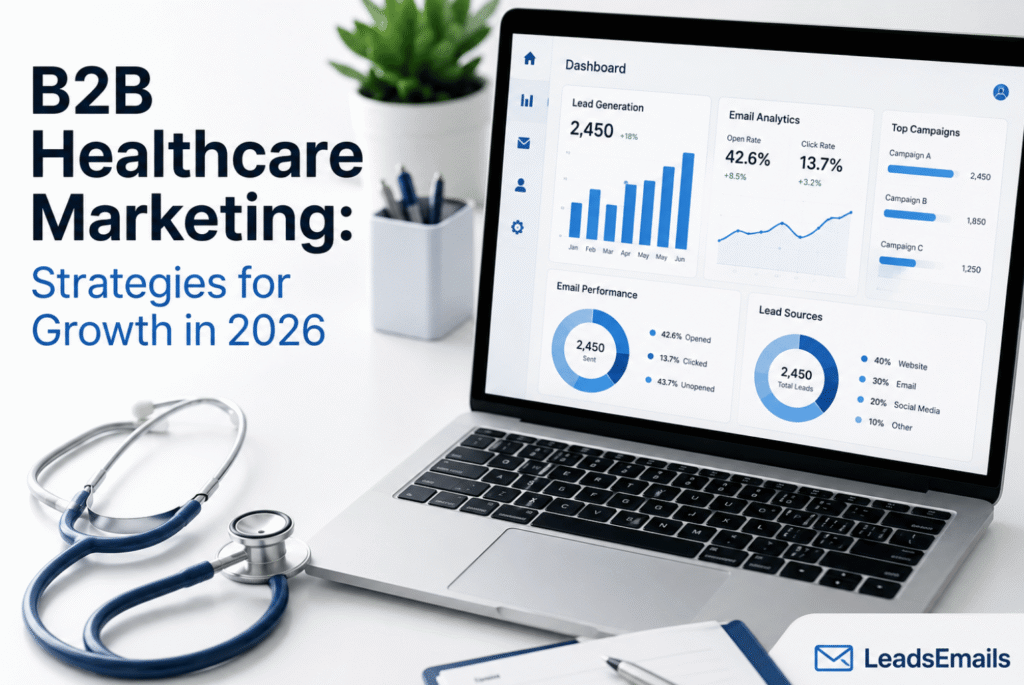
The healthcare industry is one of the most complex and most lucrative spaces in B2B marketing. Long sales cycles, multiple decision-makers, strict compliance requirements, and highly educated buyers make it unlike any other sector. Yet the organizations that master B2B healthcare marketing consistently outperform their competitors in pipeline growth, deal size, and customer retention.
This guide breaks down what B2B healthcare marketing actually is, why it’s uniquely challenging, and most importantly which strategies are driving real results in 2026.
What Is B2B Healthcare Marketing?
B2B healthcare marketing refers to the strategies and tactics used by companies that sell products or services to other healthcare organizations, hospitals, clinics, insurance providers, pharmaceutical companies, medical device manufacturers, or health tech platforms rather than directly to patients.
If you sell EHR software, medical equipment, revenue cycle management tools, staffing solutions, or healthcare data products, you are operating in B2B healthcare marketing.
B2B vs. B2C Healthcare Marketing: Key Differences That Change Everything
Most marketing playbooks are written for consumer audiences. In B2B healthcare, the rules are fundamentally different.
B2C healthcare marketing targets patients. It focuses on emotional appeals, simple messaging, and short decision windows.
B2B healthcare marketing targets administrators, procurement teams, clinicians, IT leaders, and C-suite executives often all at once. Decisions involve committees of 6 to 10 stakeholders, budgets requiring board approval, and sales cycles stretching 13 months or longer.
The buyer is not one person. The message cannot be generic. And trust is everything.
Why B2B Healthcare Marketing Is Harder Than Any Other Industry
Despite substantial increases in digital marketing investment since the pandemic, many healthcare organizations struggle to demonstrate corresponding improvements in pipeline quality and conversion rates. The explanation is structural, not tactical.
The structural challenges include:
- Regulatory complexity HIPAA, GDPR, and emerging AI regulations create strict guardrails around data use and messaging
- Multi-stakeholder buying committees clinicians, IT, compliance, and finance must all be convinced
- Long sales cycles complex buying committees now drive 13+ month sales cycles
- High stakes decisions buyers are cautious because a wrong vendor choice affects patient outcomes and legal liability
- Information overload decision-makers are bombarded with vendor outreach daily
Understanding these constraints is not a reason to pull back. It is the reason to build a smarter strategy.
Build Your Foundation First
Before running campaigns, three foundational elements must be in place.
Define Your Ideal Customer Profile (ICP) for Healthcare
Your ICP in healthcare should go beyond job title and company size. It should include the type of facility (hospital system vs. independent clinic vs. health tech platform), the EHR systems they use, their regulatory environment, their current tech stack, and the specific pain points driving their buying decisions this year.
The more precise your ICP, the more targeted and cost-effective every downstream marketing activity becomes.
Craft a Value Proposition That Speaks to Clinical and Financial ROI
Healthcare buyers are accountable to two masters: patient outcomes and budget performance. Your value proposition must speak to both. Vague claims about “streamlining workflows” do not convert. Specific statements reducing claim denials by 23%, cutting administrative hours by 40%, or improving patient throughput do.
B2B healthcare marketing is about building relationships and trust with key stakeholders in the medical field. Your value proposition is where that trust begins.
Build a Compliance-Ready, High-Converting Website
Your website is your most important sales asset. In healthcare B2B, it must load fast, be accessible, demonstrate credibility through certifications and case studies, and be fully compliant with privacy regulations. A poorly built website signals risk to a buyer whose entire business is built on trust.
How to Align Marketing and Sales in a 13+ Month Healthcare Sales Cycle
One of the most common reasons B2B healthcare marketing fails is the gap between marketing and sales. Marketing generates MQLs; sales ignores them. Sales closes deals marketing never hears about. The feedback loop breaks.
Close collaboration between marketing and sales enables faster lead follow-up, consistent messaging, and higher conversion rates in complex healthcare buying cycles.
Practical alignment tactics:
- Define shared lead qualification criteria (MQL vs. SQL) together
- Build content that sales can use in active deals — one-pagers, battle cards, ROI calculators
- Hold weekly pipeline reviews where both teams assess lead quality
- Feed sales intelligence back into campaign targeting
FAQs
What makes B2B healthcare marketing different from other B2B sectors?
The combination of regulated data, multi-stakeholder buying committees, clinical credibility requirements, and extended sales cycles makes healthcare B2B uniquely complex. Generic marketing tactics produce poor results. Precision, compliance, and education-first content are non-negotiable.
How does HIPAA affect your digital marketing strategy?
HIPAA restricts the use of patient data in any form of marketing. In B2B contexts, it governs how you handle data from healthcare organization contacts and requires BAAs with all marketing technology vendors that process covered data.
Why is ABM the best fit for healthcare lead generation?
Because healthcare buying decisions involve large committees, long timelines, and high contract values, mass-market lead generation creates low-quality volume. ABM focuses resources on accounts most likely to close, resulting in higher pipeline quality and better ROI.
What are the best channels for B2B healthcare leads?
Email marketing, LinkedIn, SEO-driven content, webinars, and targeted paid media on healthcare-specific platforms consistently outperform in this sector. The right mix depends on your ICP and where your specific buyers spend their time.
How long is a typical B2B healthcare sales cycle?
For mid-market and enterprise healthcare deals, the average sales cycle runs between 9 and 18 months. Marketing’s role is to maintain relevance and build trust across every stage of that journey not just generate top-of-funnel awareness.
How does content marketing build trust with clinical decision-makers?
Clinical buyers trust peers, data, and evidence. Content that features real outcomes, third-party validation, and peer-level expertise rather than promotional messaging builds the credibility needed to advance deals in this environment.
