
How to Build a Perfect B2B Marketing Funnel? The Ultimate Guide
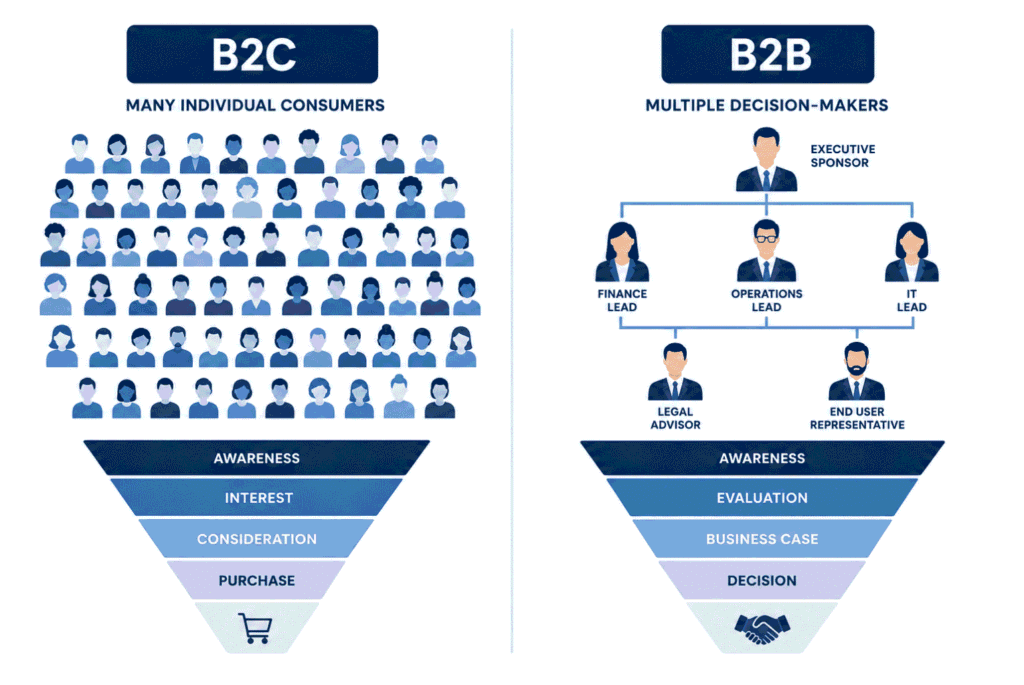
Every B2B business wants more leads, shorter sales cycles, and higher revenue but most fall short because they lack a structured approach to guiding prospects from awareness to purchase. The answer? A well-built B2B marketing funnel.
In this ultimate guide, you’ll learn exactly what a B2B marketing funnel is, why it matters, how to build one, and the proven strategies to maximize every stage of the journey.
What is a B2B Marketing Funnel?
A B2B marketing funnel is a framework that maps out the journey a business buyer takes from the moment they first discover your brand to the point they become a paying customer (and beyond). Unlike B2C funnels that cater to individual consumers making quick decisions, B2B funnels account for longer sales cycles, multiple decision-makers, and high-value transactions.
The funnel metaphor exists for a reason: a large number of prospects enter at the top, but only a qualified subset moves through to the middle and bottom stages. Each stage requires a different marketing approach, messaging, and content type to nurture prospects effectively.
At its core, the B2B marketing funnel aligns your marketing and sales teams around a shared understanding of the buyer journey ensuring no lead falls through the cracks.
Advantages of Creating a B2B Marketing Funnel
Building a deliberate marketing funnel isn’t just a best practice it delivers measurable business results. Here’s why investing in one pays off:
1. Improved Lead Quality A funnel filters out poor-fit prospects early. By targeting the right audience with the right message at each stage, you attract leads who are genuinely interested in your solution not just casual browsers.
2. Shorter Sales Cycles When leads are properly nurtured through the funnel with relevant content and timely follow-ups, they arrive at the sales conversation already informed and pre-sold. This dramatically reduces the time your sales team spends educating prospects from scratch.
3. Better Marketing-Sales Alignment A defined funnel creates a shared language between marketing and sales. Both teams know exactly when a lead is ready to be handed off, what “qualified” looks like, and what touchpoints have already occurred.
4. Higher Conversion Rates Stage-specific content and personalized outreach consistently outperform generic, one-size-fits-all messaging. A structured funnel ensures every touchpoint is purposeful and conversion-focused.
5. Predictable Revenue With a funnel in place, you can track conversion rates between each stage, forecast pipeline, and identify bottlenecks before they hurt your bottom line.
6. Deeper Customer Insights Monitoring funnel metrics reveals how buyers behave, what content resonates, and where prospects drop off intelligence that continuously improves your marketing strategy.
The 3 Stages of a B2B Marketing Funnel
The B2B marketing funnel is typically divided into three core stages, each representing a distinct phase of the buyer’s journey.
Stage 1: Top of the Funnel (TOFU) Awareness
At the top of the funnel, your goal is simple: get noticed. Prospects at this stage are either unaware of your brand or just beginning to recognize they have a business problem. They’re not ready to buy they’re exploring.
Your job here is to attract a wide audience and build brand credibility. Content at this stage should educate, inform, and entertain rather than sell. Effective TOFU formats include:
- Blog posts and thought leadership articles
- Social media content (especially LinkedIn for B2B)
- SEO-optimized landing pages
- Paid awareness campaigns (display ads, sponsored content)
- Webinars, podcasts, and video content
- Press releases and industry news coverage
Key metric: Traffic, impressions, brand reach, and new visitors.
Stage 2: Middle of the Funnel (MOFU) Consideration
Prospects in the middle of the funnel have acknowledged they have a problem and are now actively researching solutions. They know who you are now they’re evaluating whether you’re the right fit.
This is where lead nurturing becomes critical. You want to demonstrate your expertise, differentiate from competitors, and deepen the relationship. Effective MOFU content includes:
- Case studies and customer success stories
- Whitepapers, eBooks, and in-depth guides
- Email nurture sequences
- Product comparison pages
- Webinars and live demos
- Free tools, templates, or calculators
Key metric: Lead quality, email open/click rates, content downloads, and demo requests.
Stage 3: Bottom of the Funnel (BOFU) Decision
At the bottom of the funnel, prospects are close to making a purchase decision. They’ve done their research now they need the final push of confidence to choose you over a competitor.
This stage is where marketing and sales overlap most heavily. Content and tactics here should reduce friction, address final objections, and make it easy to say yes. Effective BOFU strategies include:
- Free trials or product demos
- Personalized proposals and pricing pages
- ROI calculators and business case templates
- Testimonials, reviews, and reference calls
- Retargeting ads with conversion-focused messaging
- Direct sales outreach and consultation offers
Key metric: Conversion rate, cost per acquisition (CPA), and closed revenue.
Building a Successful B2B Marketing Funnel
Understanding the stages is one thing building a funnel that actually works is another. Here’s a step-by-step approach:
Step 1: Define Your Ideal Customer Profile (ICP)
Before building anything, get crystal clear on who you’re targeting. Your ICP should include firmographic details (industry, company size, revenue, geography), technographic data (tools they use), and the specific pain points your product solves. The more precise your ICP, the more relevant every funnel touchpoint becomes.
Step 2: Map the Buyer Journey
Interview your best customers and your sales team to understand how buyers actually move through your funnel. What triggers their initial search? What questions do they ask during evaluation? What almost made them choose a competitor? This journey map becomes your content and messaging blueprint.
Step 3: Create Stage-Specific Content
Build a content library that addresses your buyer’s needs at each funnel stage. Don’t just create content create content with a purpose. Every asset should have a clear call-to-action (CTA) that moves the prospect to the next stage.
Step 4: Set Up Lead Capture and Scoring
Use gated content, forms, and landing pages to capture lead information. Implement a lead scoring model that assigns points based on demographic fit and behavioral signals (pages visited, content downloaded, emails opened). This helps your sales team prioritize the hottest leads.
Step 5: Build Automated Nurture Sequences
Not every lead is ready to buy today. Set up email automation workflows that deliver relevant content to prospects based on their stage and behavior. A prospect who downloaded a whitepaper should receive different follow-up than one who watched a product demo.
Step 6: Align Sales and Marketing on Handoff Criteria
Define precisely what a Marketing Qualified Lead (MQL) and a Sales Qualified Lead (SQL) look like. Establish an SLA between marketing and sales: how quickly will sales follow up on an MQL? What actions should marketing take if a lead goes cold?
Step 7: Measure, Analyze, and Optimize
Track conversion rates between every funnel stage. Identify where leads are dropping off and test new approaches to improve those transitions. Funnel optimization is never finished it’s a continuous cycle of measurement and improvement.
B2B Marketing Funnel Strategies
Beyond the foundational build, these strategies will amplify performance across your entire funnel:
Account-Based Marketing (ABM)
Rather than casting a wide net, ABM focuses your marketing resources on a specific list of high-value target accounts. This hyper-personalized approach aligns marketing and sales from day one and typically delivers higher win rates for enterprise deals.
Content Marketing and SEO
A consistent stream of high-quality, search-optimized content keeps your brand visible throughout the buyer’s entire research journey. Long-form content, pillar pages, and topic clusters build domain authority while attracting organic traffic at every funnel stage.
Email Marketing and Drip Campaigns
Email remains one of the highest-ROI channels in B2B. Well-segmented, behavior-triggered drip campaigns keep your brand top-of-mind and deliver the right message at exactly the right moment in the buyer journey.
LinkedIn and Paid Social
LinkedIn is the premier platform for B2B audience targeting. Sponsored content, InMail campaigns, and thought leadership posts allow you to reach decision-makers by job title, industry, company size, and more making it ideal for both awareness and retargeting campaigns.
Retargeting Campaigns
Not every visitor converts on their first visit. Retargeting ads re-engage prospects who have shown interest but haven’t yet taken the next step keeping your brand in front of them as they continue their evaluation process.
Webinars and Virtual Events
Webinars serve double duty: they generate qualified leads while simultaneously nurturing them. A well-run webinar positions your team as experts, educates your audience, and creates a natural segue into a sales conversation.
Sales Enablement Content
Give your sales team the right tools to close deals. Battle cards, ROI calculators, competitive comparison guides, and objection-handling frameworks help salespeople navigate the final stages of the funnel with confidence.
Data-Driven Personalization
Use behavioral data, CRM insights, and intent data to personalize your outreach at scale. Personalized emails, dynamic website experiences, and targeted ad creative all perform significantly better than generic alternatives.
Boost Your B2B Marketing Funnel with LeadsEmails
A B2B marketing funnel is only as strong as the data powering it. If you’re reaching out to outdated contacts, incorrect decision-makers, or companies outside your ICP, your funnel will leak at every stage no matter how well it’s structured.
LeadsEmails provides verified, intent-driven B2B contact data that supercharges every layer of your funnel:
- Precise ICP Targeting: Access a database of millions of verified contacts segmented by industry, job title, company size, geography, and technology usage so you’re always reaching the right people.
- TOFU Acceleration: Fuel awareness campaigns with accurate prospect lists that match your ideal customer profile from day one.
- MOFU Enrichment: Enrich your existing leads with firmographic and technographic data to score them more accurately and personalize nurture sequences.
- BOFU Precision: Identify decision-makers and buying committee members at your target accounts so your sales team can close faster.
- Real-Time Data Verification: LeadsEmails data undergoes continuous verification to ensure deliverability and accuracy reducing bounce rates and wasted outreach.
Whether you’re running an ABM program, scaling your outbound efforts, or rebuilding your demand generation engine, LeadsEmails gives you the data foundation to make every funnel stage more effective.
Conclusion
A high-performing B2B marketing funnel doesn’t happen by accident. It’s built with a clear understanding of your buyer, stage-specific content and tactics, tight alignment between marketing and sales, and a commitment to continuous optimization.
The businesses that win in competitive B2B markets are those that treat the funnel not as a static diagram, but as a living system one they measure rigorously, refine constantly, and fuel with quality data.
Start with your ICP. Map the journey. Build the content. Align the teams. Measure everything. And let data lead the way.
FAQs
What is a full funnel marketing strategy in B2B?
A full funnel marketing strategy in B2B is an integrated approach that addresses every stage of the buyer journey from initial awareness (TOFU) through consideration (MOFU) to purchase decision (BOFU) with targeted content, messaging, and tactics designed for each phase. Rather than focusing solely on lead generation or closing deals, a full funnel strategy ensures consistent, coordinated engagement across the entire journey, resulting in higher-quality leads, better conversion rates, and stronger customer relationships.
What is the top of the funnel in B2B?
The top of the funnel (TOFU) in B2B represents the awareness stage, where potential buyers first encounter your brand. At this stage, prospects are recognizing a business challenge and beginning to explore solutions but they’re not yet evaluating specific vendors. B2B marketers use content like blog posts, SEO articles, social media, webinars, and paid awareness campaigns to attract a broad audience and build credibility. The primary goal is visibility and education, not selling.
Is it necessary to build both B2B marketing and sales funnels?
Yes and ideally, they should be unified into a single, connected revenue funnel. The marketing funnel covers the awareness and consideration stages (attracting and nurturing leads), while the sales funnel covers the evaluation and decision stages (qualifying and closing deals). Building both ensures no gap exists between when marketing hands off a lead and when sales engages it. When aligned, both funnels share data, use consistent messaging, and work toward the same pipeline and revenue goals. Siloed funnels are one of the most common reasons B2B companies lose qualified leads.
What are the KPI stages of the funnel?
Each funnel stage has its own set of key performance indicators (KPIs):
Top of Funnel (Awareness): Website traffic, impressions, organic search rankings, social media reach, new visitors, and cost per click (CPC).
Middle of Funnel (Consideration): Lead volume, Marketing Qualified Leads (MQLs), email open and click-through rates, content download rates, webinar attendance, and time-on-page.
Bottom of Funnel (Decision): Sales Qualified Leads (SQLs), demo-to-close rate, cost per acquisition (CPA), sales cycle length, win rate, and closed revenue.
Post-Funnel (Retention): Customer lifetime value (CLV), net promoter score (NPS), churn rate, and expansion revenue.
What are B2B marketing funnel metrics?
B2B marketing funnel metrics are the quantitative measurements used to evaluate the effectiveness of each funnel stage. The most important ones include:
- Lead-to-MQL Conversion Rate: The percentage of raw leads that meet your marketing qualification criteria.
- MQL-to-SQL Conversion Rate: The percentage of MQLs accepted and advanced by your sales team.
- SQL-to-Opportunity Rate: How many SQLs turn into active sales opportunities.
- Opportunity-to-Close Rate: The percentage of opportunities that result in a won deal.
- Cost Per Lead (CPL): Total marketing spend divided by the number of leads generated.
- Customer Acquisition Cost (CAC): Total sales and marketing spend divided by the number of new customers won.
- Average Deal Size: The average revenue value of a closed deal.
- Sales Cycle Length: The average number of days from first contact to closed deal.
- Pipeline Velocity: How quickly revenue moves through your pipeline, calculated by multiplying the number of opportunities, average deal size, and win rate then dividing by sales cycle length.
Tracking these metrics consistently gives you the insight needed to identify bottlenecks, allocate budget effectively, and continuously improve funnel performance.
